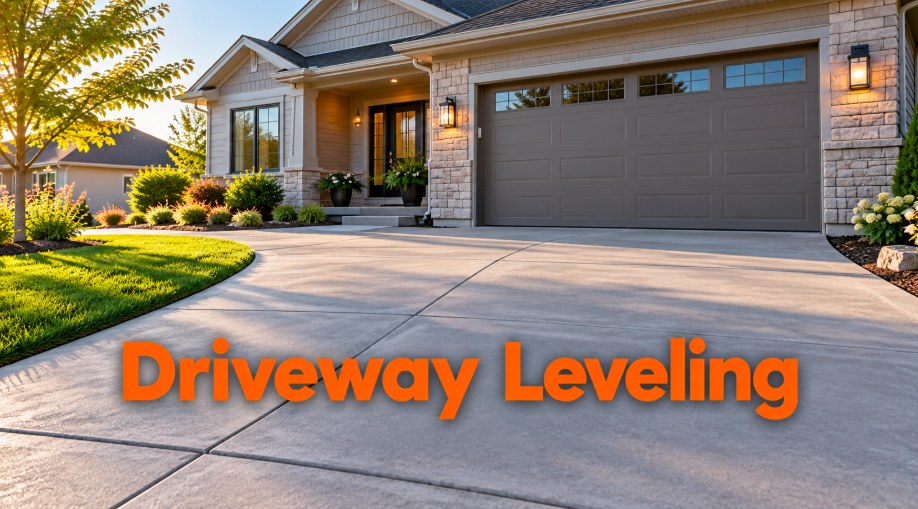
A sunken or uneven driveway can quickly become more than an appearance problem. Low sections may collect water, raised edges can create trip hazards, and changes in elevation can make pulling vehicles into a garage uncomfortable. Driveway leveling is designed to correct many of these problems by lifting existing concrete slabs back toward a safer and more functional position without automatically replacing the entire driveway.
Professional Driveway Leveling Services
Concrete driveways are built to handle heavy use, but the soil beneath them can change over time. Poor compaction, erosion, drainage problems, soil movement, and repeated moisture changes may leave empty spaces underneath a slab. Once the concrete loses consistent support, one portion of the driveway can begin to settle.
Driveway leveling addresses the underlying loss of support rather than simply covering the surface. Depending on the condition of the driveway, small access points can be used to introduce leveling material beneath the concrete. The material fills voids and helps raise the affected slab in a controlled manner.
The goal is to improve slab alignment while preserving as much of the existing driveway as possible.
Common Driveway Problems We Level
Driveway leveling may be appropriate for:
- Sunken driveway sections
- Uneven concrete slabs
- Low areas near the garage
- Trip hazards between slab joints
- Water collecting in settled areas
- Concrete that has dropped near sidewalks
- Uneven transitions between the driveway and street
- Slabs affected by soil erosion
- Driveways with isolated settlement
- Concrete that rocks because of hollow areas underneath
Every driveway should be inspected individually because settlement patterns are rarely identical from one property to another.
Why Driveways Become Uneven
Driveway slabs are heavy. They depend on stable soil and a properly prepared base to remain in position.
Water is one of the most common contributors to settlement. Runoff from roofs, irrigation systems, landscaping, or poor grading can move fine soil particles away from beneath the driveway. When enough supporting material disappears, the slab may begin dropping into the resulting void.
Other properties may experience settlement because the soil underneath the original driveway was not compacted adequately during construction.
Tree roots, plumbing leaks, changing soil moisture, nearby excavation, and age can also contribute.
Determining why the driveway settled is an important part of deciding how the repair should be approached.
Leveling Instead of Complete Replacement
Not every uneven driveway needs to be demolished.
When the concrete itself remains reasonably solid, leveling may provide a much less disruptive option than tearing out and repouring the entire surface.
Keeping the existing concrete can reduce:
- Demolition
- Heavy debris removal
- Construction disturbance
- Landscape disruption
- Long curing periods
- Replacement costs
Replacement may still be necessary when slabs are severely broken, extensively deteriorated, or structurally unsuitable for lifting. A proper inspection helps distinguish settlement problems from concrete that has reached the end of its useful condition.
Improving Driveway Drainage
Settlement often changes the way water travels across a driveway.
A slab that originally directed rainwater toward the street may begin sending water toward a garage, walkway, landscaping bed, or foundation after it sinks.
Strategic leveling can help restore more appropriate elevations and improve surface drainage. Although leveling cannot correct every drainage problem, adjusting settled slabs can often reduce unwanted puddles and low spots.
Drainage conditions around the property should also be reviewed so that continuing erosion does not undermine the repaired area.
Garage and Driveway Transitions
One of the most noticeable driveway settlement problems occurs directly outside the garage.
When the driveway drops below the garage floor, vehicles may experience a hard bump entering or leaving. The vertical edge can also become a walking hazard.
Where conditions permit, the affected driveway slab may be raised closer to the elevation of the garage entrance. Careful leveling is important because the slab must be adjusted without pushing excessive pressure against the garage structure.
Extend the Use of Your Existing Driveway
An uneven driveway does not always mean you need an entirely new driveway.
Addressing settlement early can help prevent larger height differences from developing and improve the usability of the concrete you already have.
Professional driveway leveling can create a smoother driving surface, reduce common trip hazards, improve drainage, and restore a cleaner appearance to your property.