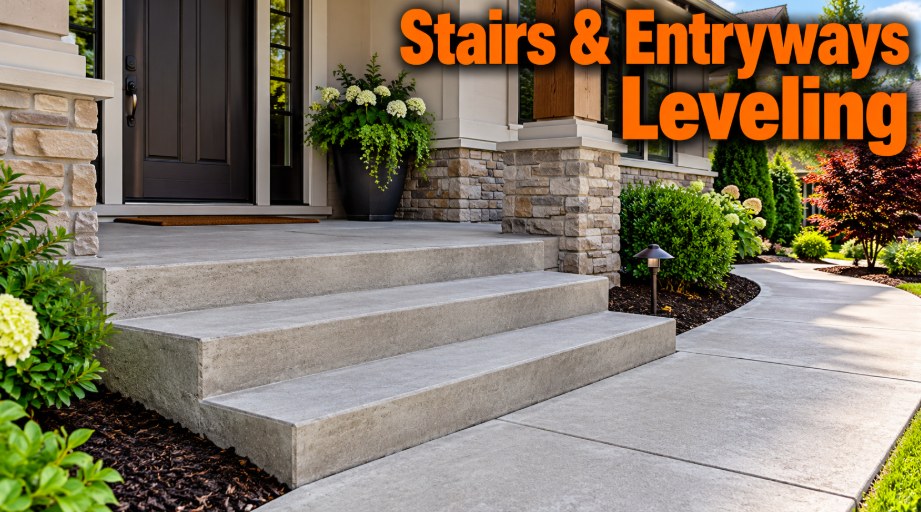
The entrance to a home or business is one of the most frequently used areas of the property. When concrete landings, approach slabs, or adjacent walkways begin sinking, the change in elevation may affect the comfort and safety of every person entering the building.
Stairs and entryway leveling focuses on correcting settled concrete around these important transitions.
Leveling Concrete Around Entrances
Entry areas often contain several different components positioned close together:
- Concrete steps
- Landings
- Porches
- Walkways
- Driveway approaches
- Door thresholds
- Columns
- Foundation walls
When one section moves while another remains stationary, uneven transitions can develop.
Leveling can sometimes reposition settled slabs and improve the relationship between these surfaces.
Uneven First or Last Steps
A staircase is designed around relatively consistent riser heights.
When the landing or walkway at the bottom of the stairs settles, the first step may become noticeably taller.
When concrete at the top moves, the relationship with the final step or doorway may also change.
Correcting the elevation of the adjacent slab can help restore a more natural transition.
The stairs themselves must be evaluated carefully before deciding whether lifting is appropriate.
Entryway Trip Hazards
People often approach a door while carrying groceries, packages, tools, luggage, or other items.
That makes unexpected changes in concrete elevation especially inconvenient.
Settlement may create raised edges where:
- Walkways meet porches
- Landings meet steps
- Concrete meets a doorway
- Entry slabs meet driveways
- Ramps connect to flat surfaces
Reducing these elevation differences can make the entrance easier to use.
Water Near Exterior Doors
A sunken entry slab may begin collecting water directly outside a building.
In other cases, the altered slope causes water to move toward the door instead of away from it.
This can contribute to staining, moisture around thresholds, and continued erosion beneath the slab.
Leveling can improve surface drainage when settlement is responsible for the low area.
Downspouts, landscape grading, and irrigation should also be checked.
Why Entryway Concrete Settles
The soil around a building is often disturbed during original construction.
Foundation excavation is later backfilled, and that soil may continue settling if it was not compacted thoroughly.
Concrete landings or walkways built over the backfilled area can drop as the soil beneath them consolidates.
Additional causes include:
- Roof runoff
- Plumbing leaks
- Poor grading
- Soil erosion
- Expansive soil
- Irrigation
- Voids under the concrete
Entry settlement is therefore common even when surrounding concrete remains stable.
Attached and Unattached Concrete
Not every stair, landing, or porch can be moved in the same way.
Some concrete components are connected to the building while others were poured separately.
A slab attached to the foundation behaves differently from a floating walkway.
Understanding these connections is essential because lifting one component may place pressure on another.
When Replacement May Be Better
Leveling is primarily intended to correct settlement in concrete that remains reasonably intact.
Replacement may be more appropriate when stairs or landings have:
- Major structural cracks
- Broken corners affecting stability
- Severe deterioration
- Exposed reinforcing steel
- Extensive displacement
- Inadequate original construction
A careful inspection helps determine which repair approach makes sense.
Improve the First Step Onto Your Property
An uneven entryway affects one of the most visible and heavily used parts of a building.
Correcting settled concrete can improve walking transitions, reduce low areas, support better drainage, and restore a cleaner approach to the entrance.
When the existing concrete is still in good condition, leveling may provide a practical alternative to removing and rebuilding the entire entry area.