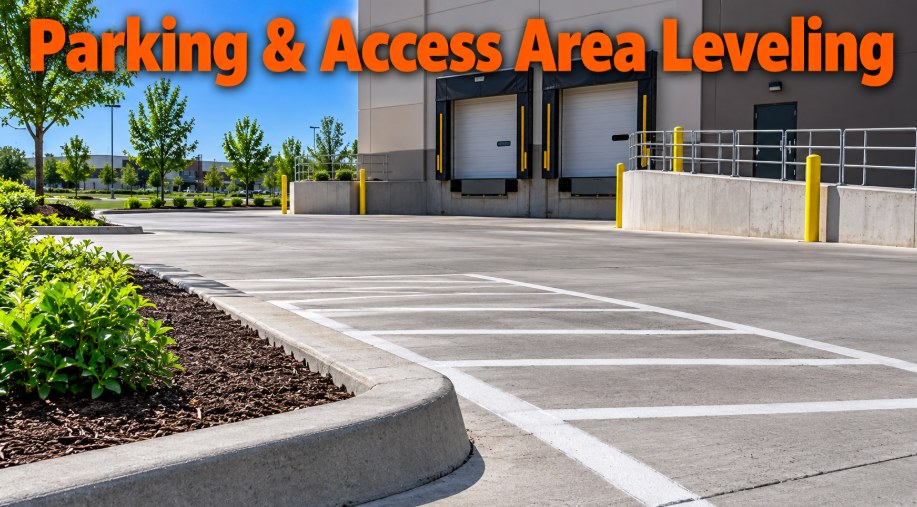
Parking and access areas are expected to handle much more than ordinary foot traffic. Vehicles repeatedly enter, stop, turn, load, unload, and travel across the concrete. When slabs settle, those movements can become rougher and low areas may collect water.
Concrete leveling can restore many uneven parking and access surfaces while allowing usable concrete to remain in place.
Leveling Concrete in High-Traffic Areas
Parking areas can contain multiple slabs covering a wide surface.
Settlement may affect one isolated section or extend across several neighboring slabs.
Common areas requiring attention include:
- Parking stalls
- Drive aisles
- Loading areas
- Dumpster access pads
- Service entrances
- Apartment parking areas
- Small commercial lots
- Private access lanes
- Concrete approaches
- Vehicle turnaround areas
Because each area handles traffic differently, repair planning should consider how the surface is used.
What Causes Parking Slabs to Settle?
Repeated vehicle traffic can expose weaknesses in the supporting base, but traffic alone is not always the main cause.
Settlement is frequently connected to conditions beneath the concrete.
Examples include:
- Poor base compaction
- Water infiltration
- Soil erosion
- Drainage failures
- Underground pipe leaks
- Utility trenches
- Improper backfill
- Heavy localized loads
Once support beneath a slab becomes inconsistent, repeated traffic can make the resulting movement more noticeable.
Uneven Vehicle Transitions
A vertical difference between slabs may create a hard bump for cars, delivery vehicles, equipment, shopping carts, or trailers.
The repeated impact can make the area uncomfortable to use and may place additional stress on concrete edges.
Leveling lower slabs can reduce these abrupt transitions.
Pedestrian Safety in Parking Areas
Drivers are not the only users of parking lots.
Customers, employees, residents, delivery workers, and visitors regularly cross concrete parking surfaces on foot.
Sunken slabs may create trip points in areas where people are also watching for traffic.
Improving concrete alignment can make these transitions easier to navigate.
Drainage and Standing Water
Low parking slabs can trap water after rain or cleaning.
Pooling water may collect dirt, accelerate staining, enter joints, and contribute to ongoing soil problems.
Where settlement has changed the intended drainage pattern, leveling can sometimes restore a more favorable slope.
Drains, gutters, landscaping, and surrounding pavement should also be considered.
Access Areas Near Buildings
Concrete directly outside commercial doors, garages, loading zones, and service entrances requires additional care.
The elevation may need to coordinate with:
- Door thresholds
- Ramps
- Curbs
- Drains
- Asphalt surfaces
- Sidewalks
- Loading equipment
Controlled lifting helps improve settlement while working within these fixed elevations.
Minimizing Business Disruption
Replacing large areas of concrete can involve demolition equipment, debris removal, forming, pouring, curing, and extended access restrictions.
When existing slabs are suitable for lifting, leveling may offer a more targeted approach.
Keeping the original concrete also avoids unnecessary replacement of stable surrounding slabs.
Evaluating Heavy-Duty Concrete
Commercial and parking surfaces vary significantly in thickness and construction.
Before lifting begins, the concrete should be evaluated for cracking, deterioration, load conditions, and accessibility.
Severely damaged slabs or concrete affected by structural failures may be better candidates for replacement.
Improve Access Without Rebuilding the Entire Area
Settlement does not automatically mean an entire parking surface needs replacement.
When concrete remains structurally serviceable, leveling can help restore smoother vehicle movement, improve pedestrian transitions, address low areas, and extend the useful life of the existing slabs.